
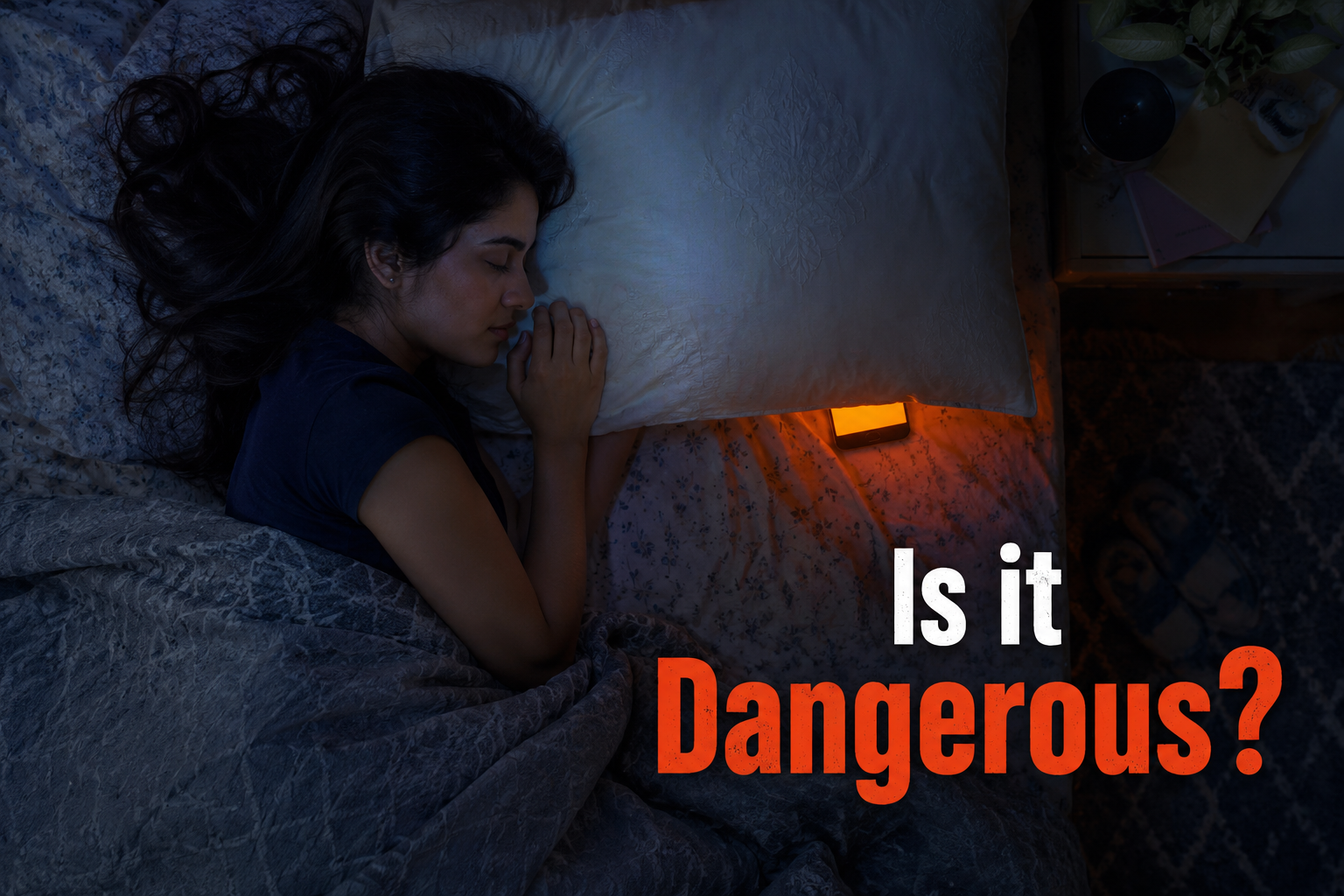
You plug your phone in, slide it under your pillow so the alarm wakes only you, and drift off. It feels harmless — almost cozy. But sleeping with your phone under your pillow has quietly become one of the most common bedtime habits, and also one of the most debated. So is sleeping with phone under your pillow dangerous, or just another internet scare? Here’s what actually happens when your phone spends the night pressed against your pillow, how worried you should be, and why so many of us keep doing it anyway.
The Real Risk: Heat, Not Radiation
The radiation panic around phones is mostly overblown — phones emit non-ionizing radiation, a low-level form of EMF and the same type as a baby monitor, and no major health body has linked it to cancer or serious illness. The risk that’s actually worth your attention is heat. Phones can become a real fire hazard when left charging under a pillow because the fabric traps heat around the device, preventing it from properly dissipating. A pillow blocks airflow, and a charging battery already runs warmer than usual — trap that heat for eight hours and you’ve created the exact conditions battery manufacturers warn against.
This comes down to basic battery chemistry. Most phones run on lithium-ion batteries, which are safe under normal conditions but become unstable when they can’t release heat. Charging naturally raises a battery’s temperature, and a soft, insulating surface like a pillow or thick blanket stops that heat from escaping. The result is a slow buildup that can cause the battery to swell, degrade faster over time, or — in rare but well-documented cases — overheat to the point of combustion. You don’t need a faulty phone for this to happen; ordinary bedding combined with a heat-generating device is enough on its own.
It’s Quietly Wrecking Your Sleep, Too
Even when there’s no fire risk at all, an unplugged phone under your pillow is still working against you. Notifications, vibrations, and the faint blue glow when the screen lights up are enough to pull your brain out of deep sleep without fully waking you — you just feel groggier the next morning without knowing why. Blue light exposure, even brief, suppresses melatonin and delays your body’s wind-down signal, throwing off the circadian rhythm that’s supposed to keep you on a consistent sleep-wake cycle. Over weeks and months, those small nightly interruptions add up to fragmented sleep that never quite resets your body the way deep, uninterrupted rest should.
Add the psychological pull of “just checking one notification,” and your phone under the pillow becomes less of a fire-safety issue and more of a chronic sleep-quality issue — one that’s much easier to overlook because it doesn’t feel dramatic in the moment.
Why We Do It Anyway
If the risks are real, why is this habit so common? Mostly convenience and a bit of anxiety. Tucking the phone under the pillow muffles the alarm just enough that it wakes only you and not a partner, keeps it within reach for a 3 a.m. check, and feels more “secure” than leaving it across the room. None of that is irrational — it’s a habit built around genuine needs (a private alarm, quick access, peace of mind) that just happens to come with a hidden cost most people have never thought to question.
So What Should You Actually Do?
You don’t need to banish your phone from the bedroom — just change where it sits at night.
- Charge it on a hard, flat surface — a nightstand or desk, never on or under soft fabric.
- Switch to Do Not Disturb mode instead of relying on physical distance to block notifications.
- Keep it at least an arm’s length away so the glow and vibration don’t register while you’re trying to fall asleep.
- Use a basic alarm clock if the only reason it’s under your pillow is to hear the alarm — it solves the original problem without the risk.
- Turn on a blue-light filter or Night Shift mode for the rare late-night glance, so even an accidental peek doesn’t fully wake up your brain.
FAQs
Is it safe to sleep with your phone next to your pillow if it’s not charging? It’s far safer than charging it underneath, since the fire risk comes mainly from trapped heat during charging. Notifications and blue light can still disrupt sleep, though, so Do Not Disturb mode is still worth using.
Does phone radiation while sleeping actually cause harm? Current research doesn’t support that phone radiation at typical exposure levels causes harm — heat buildup and sleep disruption are the more evidence-backed concerns.
How far away should my phone be while I sleep? An arm’s length away on a hard surface is generally enough to avoid both the heat risk and most of the light and vibration disturbances, while still keeping it close enough for an alarm.
Conclusion
So, is sleeping with your phone under your pillow dangerous? Not in the way most people assume — it isn’t the radiation hazard it’s sometimes made out to be, but it is a real fire and sleep-quality risk, especially while charging. The fix costs nothing: move the charger to your nightstand, turn on Do Not Disturb, and let an old-school alarm clock do the one job your phone was doing anyway. Curious about more everyday habits that quietly affect your health? Subscribe to Word Trail for more myth-vs-fact breakdowns like this one.